
What is an RFP in construction? A request for proposal is a formal invitation to explain how your company would deliver a defined project or scope of work. The request typically outlines the owner's needs and asks interested firms to submit a plan, qualifications, schedule, and pricing. For general contractors, subcontractors, and suppliers, understanding the RFP is only part of the job. The other part is deciding whether the opportunity fits and building useful project context before the deadline starts.
Talk with our team about your project pipeline
What is an RFP in construction, and why does it matter?
RFP stands for request for proposal. In construction, an owner, developer, public agency, or another project lead uses an RFP to invite qualified firms to explain their proposed response to a project need. The request may cover a complete building project, a construction management role, preconstruction services, design-build delivery, a trade package, or a supply scope.
An RFP is both a request for information and a selection process. It tells respondents what the issuer wants to accomplish, what to include, how proposals will be evaluated, and when materials are due. The selected firm is not necessarily the one with the lowest bid. Evaluation may consider technical approach, relevant experience, staffing, schedule, risk controls, project understanding, and price. The actual criteria and their weighting should be in the solicitation, not assumed.
RFPs vary by issuer and delivery method. Some ask for a detailed technical and commercial proposal. Others are shorter and direct bidders to provide a price against a defined scope. Always read the specific package, addenda, and instructions. The acronym alone does not tell you the contract form, whether the design is complete, or how much pricing detail is expected.
How is an RFP different from an RFQ or an invitation to bid?
Procurement terms can overlap. An issuer may use them differently, so follow the definitions in the project documents. In broad terms, an RFP asks how a team would meet the need. An RFQ commonly asks about qualifications or pricing; and an invitation to bid often seeks a compliant price for a defined scope.
| Request type | Typical purpose | What a respondent may submit | Useful question to ask |
|---|---|---|---|
| Request for proposal (RFP) | Compare proposed solutions, teams, delivery plans, and commercial terms | Approach, qualifications, schedule, staffing, assumptions, and price | Which criteria matter, and how are they evaluated? |
| Request for qualifications (RFQ) | Screen experience and capability, sometimes before a later pricing stage | Project history, references, licenses where applicable, and key personnel | Will shortlisted firms receive a separate pricing request? |
| Request for quotation (also RFQ) | Obtain pricing for specified products, services, or a defined scope | Unit prices, quantities, delivery terms, exclusions, and validity period | Are quantities and specifications fixed or subject to change? |
| Invitation to bid (ITB) | Invite comparable bids against stated plans and requirements | Compliant bid forms, pricing, required certifications, and acknowledgments | What makes a bid responsive, and are alternatives allowed? |
Because RFQ can mean either request for qualifications or request for quotation, do not decide based on the acronym. Look at the requested response and the evaluation method. If the request is unclear, submit a written question through the official channel before the question deadline. Keep the response with the solicitation record.
Public procurement can use prescribed procedures and terms that differ from private-owner processes. The U.S. Environmental Protection Agency's best-practice guide for procuring services, supplies, and equipment describes procurement approaches and notes that sealed bidding is typically used for construction projects and widely available equipment. Treat that as context, not a substitute for the actual solicitation or applicable rules.

What is an RFP in construction supposed to include?
A strong response starts with understanding what the issuer has provided. Construction RFP packages may include a written scope, drawings, specifications, site information, proposed contract terms, submission forms, and a schedule for questions and decisions. The level of detail varies, especially when the design or project definition is still developing.
- Project overview: The location, intended use, current phase, owner or issuer, and high-level objectives.
- Scope and deliverables: Work requested, trade boundaries, required services, alternates, allowances, and any stated exclusions.
- Plans and specifications: Design documents, performance requirements, finish or product schedules, and referenced standards.
- Commercial instructions: Pricing format, contract conditions, insurance or bonding requirements, payment terms, and proposal validity period.
- Schedule: Site access, milestones, anticipated start and completion dates, procurement lead times, and required phasing.
- Selection criteria: The factors used to compare submissions, any minimum requirements, and whether interviews or clarifications are expected.
- Submission rules: Required forms, file format, delivery method, page limits, authorized contact, and the exact due date and time.
- Question and addendum process: How to raise questions, when answers will be issued, and how changes to the request are distributed.
Check whether drawings and specifications are complete enough to support the requested price. Note conflicts between documents, unclear trade interfaces, unavailable site details, or missing quantities. Record assumptions explicitly. If the issuer later distributes an addendum, determine whether it changes scope, price, schedule, or the response format, and acknowledge it as instructed.
For a subcontractor or supplier, the prime contractor's RFP may translate an owner's larger request into a package with a tighter deadline. Confirm the requested scope, delivery location, approved substitutions, submittal needs, warranty terms, and whether freight, taxes, or installation are included. Do not assume the prime's invitation includes every detail from the owner's solicitation.
How does the construction RFP process usually work?
Each issuer sets its own process, but a typical sequence helps teams organize effort and avoid preventable misses.
- Issue and review. The owner or lead firm distributes the request and supporting documents. Identify the decision-maker, project phase, response deadline, and mandatory requirements.
- Decide whether to pursue. Compare the project with your capabilities, geography, workload, relationships, risk tolerance, and likely commercial fit.
- Submit questions. Use the stated channel and deadline. Ask concise questions about gaps that affect scope, compliance, schedule, or pricing. Watch for written answers and addenda.
- Prepare the proposal. Assign owners for technical narrative, estimating, schedule, staffing, safety or quality materials, and required forms. Build a compliance checklist against every instruction.
- Review and submit. Confirm arithmetic, scope coverage, signatures, attachments, file naming, and delivery method. Allow time to resolve upload or delivery problems before the deadline.
- Participate in evaluation. Respond to permitted clarification requests or interviews through the named contact. Keep answers consistent with the written offer and avoid informal side-channel changes.
- Clarify award and handoff. If selected, reconcile the proposal with the final scope, schedule, exclusions, and contract. If not selected, seek useful feedback when the issuer permits it and record what can improve the next pursuit.
Public-sector work may have formal rules for communications, submissions, and award protests. Private projects can also impose strict instructions through their procurement documents. Follow the package. A late or noncompliant response can be rejected regardless of the quality of the proposed work.
How can you decide whether an RFP is worth pursuing?
A request in your inbox is not automatically a qualified opportunity. A practical go/no-go review limits wasted estimating time and makes the response stronger when the fit is real. Score each factor as strong, uncertain, or weak, then name the evidence behind the score.
- Scope fit: Can your team deliver the requested work with its current capabilities and partners? Are exclusions or interfaces manageable?
- Schedule fit: Is the response period realistic? Can you meet the proposed mobilization and completion dates without creating a conflict with committed work?
- Commercial fit: Can you price the risk using the information available? Are payment, bonding, insurance, escalation, and change terms understood well enough to evaluate?
- Customer and team fit: Do you understand the owner's priorities and the lead firm's expectations? Is there a credible path to communicate your relevant experience?
- Competition and differentiation: Can you explain why your approach fits this project instead of relying on general claims about your company?
- Information quality: Are project stage, scope, decision process, and schedule supported by documents or reliable conversations, or are key details still assumptions?
- Pursuit cost: What estimating, operations, design-assist, and executive time will the submission require? Is the expected opportunity worth that investment?
Set a decision threshold before the team spends days building a response. For example, require a named pursuit owner, verified scope fit, a plausible schedule, and a documented answer to the largest commercial risk. If a critical fact is unknown, assign someone to resolve it by a specific date. If it cannot be resolved, decide whether to qualify the offer with an assumption or decline to pursue.
Track why an opportunity advances or stops. A short record of the source, project phase, known stakeholders, scope confidence, next action, and decision owner is more useful than a long list of unqualified names. Teams can review those decisions later to see which early indicators led to worthwhile conversations and which consumed effort without improving understanding.
How can teams find context before a formal RFP arrives?
By the time a formal request is published, the owner may already have selected a delivery path, set a schedule, or started conversations with potential partners. Early awareness does not guarantee an invitation or award. It gives a business development team a chance to verify whether a project is real. Learn what is known, and develop a relevant relationship before a deadline compresses the process.
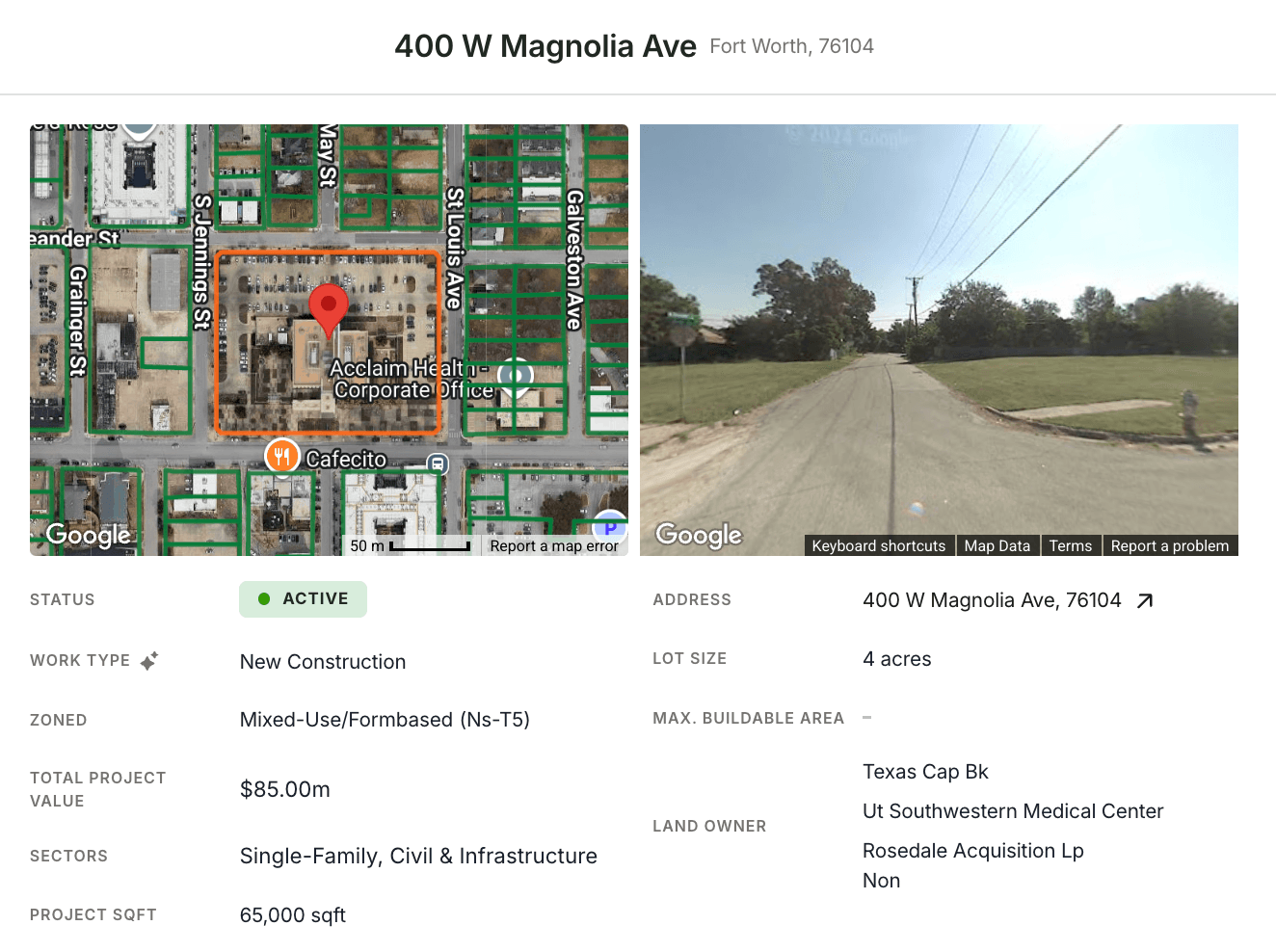
Potential early indicators can include building permits, rezoning or land-use filings, property transfers, planning applications, and public project notices. Each is a lead to investigate, not proof that construction will proceed as described. A permit can be revised or abandoned. A land transaction may not become a development. Verify the filing, its date, project status, parties, and next decision before treating it as a live pursuit.
Build a repeatable check around a defined market and project type. Review the source record, capture the parcel or project identifier, note the filing type and date, and look for corroborating information. Separate confirmed facts from interpretation. Then identify who could clarify the next step, such as a developer, architect, owner representative, or contractor already connected to the project. Keep outreach focused on a useful question rather than a premature sales pitch.
Construction teams can use permit information as one project-discovery input, alongside conversations, public records, and the team's own market knowledge. For a broader view of documented service areas, check Mercator.ai locations and the Texas construction coverage overview. Coverage should not be assumed outside the markets currently documented. A demo can help clarify what is available for a particular geography.

How should GCs, subcontractors, and suppliers use RFP intelligence?
The same project can create different opportunities for different participants. A general contractor may be assessing delivery approach and owner relationships. A subcontractor may need to know whether the scope is defined, who controls bid invitations, and when trade pricing will be requested. A supplier may need product specifications, quantities, decision timing, and the contractor or design team influencing selection.
For general contractors
Use early project context to decide which opportunities warrant relationship investment before procurement begins. Confirm the owner, likely delivery method, project phase, and known design or construction participants. If you have a legitimate connection, make an introduction that is relevant to the project's current stage. When the RFP appears, connect the proposal back to the needs and constraints already verified. Do not imply that early contact gives you privileged access or a guaranteed advantage in a formal selection.
Teams serving Texas can review Mercator.ai construction intelligence for general contractors and the Austin market page when assessing whether a documented market fits their focus. Use current project information and your own coverage checks rather than extrapolating from a single signal.
For subcontractors
Ask prospective prime contractors how and when trade packages will be issued, what plans and specifications will govern, and how questions or revisions will be handled. Build a concise record of relevant capacity, schedule constraints, comparable scope, and coordination needs. If the owner-level project is early, stay in touch with a useful update rather than treating an uncertain lead as a released bid package.
For suppliers and manufacturers
Determine when products are being evaluated and who shapes the specification. Clarify lead times, substitution procedures, samples, submittal requirements, and delivery assumptions before committing to a quoted date or price. Product selection may involve the design team, owner, contractor, and trade partner, so map the relevant stakeholders instead of assuming one contact makes the decision. See construction intelligence for building product manufacturers and suppliers for a related overview.
In each case, keep opportunity records connected to an action. A record might include a confirmed filing, last-checked date, confidence level, stakeholder to contact, question to resolve, and follow-up date. Use a shared process so estimating and business development teams can see the same project context. Mercator.ai describes its platform as tracking private construction activity from early signals through later stages; teams can review platform plans and book a live demo to determine whether it fits their workflow.
What are common mistakes in an RFP response?
- Answering a different question. A polished company overview does not replace a direct response to the requested scope and evaluation criteria.
- Skipping mandatory instructions. Missing forms, acknowledgments, signatures, or submission steps may undermine an otherwise strong proposal.
- Hiding assumptions. Unstated exclusions and ambiguous quantities can create disagreement later. Label assumptions and ask questions before the deadline.
- Pricing an unclear scope as if it were complete. Explain qualifications, allowances, alternates, and validity periods in the format requested. Do not conceal uncertainty inside a single number.
- Making unsupported claims. Use specific, relevant experience and a clear approach. Do not promise a schedule, capability, or result that the team cannot substantiate.
- Ignoring addenda. Check the official channel through the deadline, incorporate every applicable revision, and acknowledge it as required.
- Failing to learn from the outcome. Record the decision, feedback, and next relationship step. A lost pursuit can still clarify how the issuer evaluates proposals.
For practical guidance on opportunity qualification and business development, browse Mercator.ai construction business development articles and the customer stories. Use any example as a prompt for your own process, not as a substitute for the facts and requirements in a current RFP.
Discuss early project intelligence with our team
Frequently asked questions
What is the main purpose of an RFP in construction?
It gives an owner or project lead a structured way to invite proposals and compare how respondents would meet a project need. The request can define scope, submission instructions, evaluation criteria, and commercial requirements. The exact purpose depends on the documents issued.
Does an RFP always go to the lowest bidder?
No. An RFP may evaluate approach, relevant qualifications, schedule, team, risk, and price. The solicitation should explain how proposals will be evaluated. A bid process may place more emphasis on a compliant price, but the published instructions control.
Can a subcontractor or supplier respond to an RFP?
Yes, when the request invites that type of firm or a general contractor issues a trade or product package. Review the scope, submission instructions, decision process, and deadline. Confirm whether the request is asking for a proposal, qualifications, or a quotation.
What should I do if the RFP documents are incomplete?
List the missing or conflicting information that affects scope, price, schedule, or compliance. Send questions through the official process before its deadline, and check for written answers or addenda. If uncertainty remains, state assumptions or qualifications clearly when the response format permits them.
How can a team prepare before an RFP is released?
Monitor credible project signals, verify them against additional information, map relevant stakeholders, and record a specific next action. Use early context to determine whether a relationship or opportunity merits attention. Do not treat a filing or lead as confirmation that an RFP will be issued.
A strong RFP response depends on disciplined reading, a clear go/no-go decision, and evidence behind both the proposal and the project opportunity. By combining careful compliance with early, relationship-first research, construction teams can focus effort where they can make a credible contribution.