


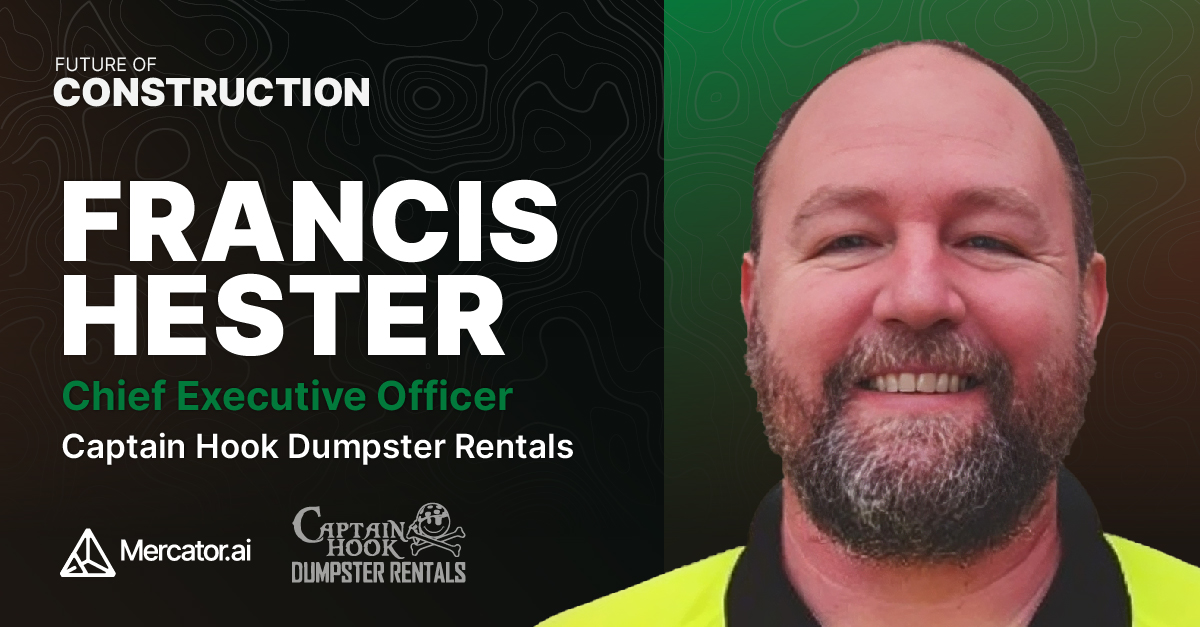
Captain Hook Dumpster Rentals’ Francis Hester on Balancing Efficiency and Effectiveness in Business
In this episode of the Future of Construction podcast, our host Chloe Smith, Founder and CEO of Mercator.ai sits down with Francis Hester, CEO of Captain Hook Dumpster Rentals, to explore the evolving landscape of the construction industry. Francis shares his entrepreneurial journey and the pivotal moments that shaped his business.
Together, they also parse the distinction between efficiency and effectiveness, emphasizing the importance of identifying the right objectives in business operations. Francis also discusses the significance of a customer-centric approach and how understanding client goals can drive success. Additionally, he highlights the challenges and opportunities of integrating technology into traditional industries, offering valuable insights for leaders looking to innovate and adapt.
#1: Leverage the Value of Reliability in Project Environments
“Okay, how can we, how do we bring value? We're bringing a big metal box and put garbage in, and then we're removing a big metal box with garbage in. Where's the thing that we could do? Well, it turns out reliability is crucial. It's crucial to our customers who are in a project environment that have to drive these projects to completion as near to the due date as they can get it and maintain whatever estimates or budgets that they set from the beginning. So what we're able to do with that understanding is we're able to figure out how to deliver consistent, reliable performance.
“So what we offer now is a next-day guarantee. If we're not there by the end of the next business day, we discount 25% for every day that we're late, and we track it. And this year we've got a 98.23, I think, percent on time completion rate. And we count all misses. If we show up and the gate is locked, if we show up and there's vehicles parked in the way and we can't service it, we still count that as a miss.
“Even in spite of counting all that, we still have a 98% reliability rating, which is why we're able to put the guarantee behind it and say, and therefore, right, if everybody's going to say we have great service, what we're saying is we have great service, and if we don't, we're going to pay for it. We're going to give you some kind of remedy for that.”
Actionable Takeaway: Reliability is crucial for clients in project environments where meeting deadlines and staying under budget are key. By offering a next-day guarantee with financial accountability, businesses can significantly enhance customer satisfaction, providing both reliability and transparency, which lead to long-term success.
#2: Empower Teams Through Context for Autonomy and Collaboration
“The thing that I realized in this last year of leading this business is that my primary role is to provide what you're calling a lens, what I would say, context, giving the appropriate context within which people understand what they're part of the whole is, and therefore can make those decisions autonomously without trying to clear things or check it. Is it okay if we… can we do this? Can we, you know, but it also enables, encourages collaboration.
“If we have the appropriate context and we realize that we're a part of a whole, what that means is I realize that my outputs are the inputs of another subsystem within this organization. And so they kind of become my customer and I've got to collaborate with them to make sure that they get their deliverables on time and high enough quality that they can produce their outputs and so on and so forth.
“But that context, or the lens is, I think, the most important thing. But from a human perspective, it gives everybody a good feeling about coming to work. Hey, I accomplished today. Why? Because these and these issues came up, and I was able to respond to them in a way without looking over my shoulder or knowing whether I was doing the right thing. I was able to respond to them because I know the context of this and how to feed the other collaborate with everyone else.”
Actionable Takeaway: Providing a clear context helps employees understand their role within the whole organization, fostering autonomy and collaboration. When individuals know their outputs are the inputs for others, teamwork thrives, leading to improved decision-making and smoother collaboration across teams.
#3: Learn and Apply the Difference between Efficiency vs. Effectiveness
“Peter Drucker had the best distinction between [efficiency and effectiveness] by saying there's a difference between doing things right and doing the right thing. We talked about increasing the efficiency of sales when operations is already. The two are disjointed. They're not collaborate, they're not coordinated, they're not synchronized. And perhaps there's not the ability to increase operational capacity at the moment.
“Doing the right thing is making sure that we get a full context of what our system is supposed to be outputting, and making sure all the teams within it are facilitating that, and synchronized and coordinated. Doing things right would be, ‘hey, we're losing a lot of prospects [that] are slipping through the cracks here. We're losing opportunities, and it appears as though we're leaving money on the table, so let's increase our efficiency.’ But now you get in a situation where the sales team can't hit their numbers because the operations team can't perform. Operations team is driven crazy, constantly switching priorities and constantly just overload every day. And the customers get less and less in terms of value, on-time deliveries, and quality.
“There's a difference between doing things right and doing the right thing. And that's where wisdom comes in. Are we doing the right thing instead of everybody trying to become more and more and more efficient — here's what else he said I love so much. He said if you're doing the wrong thing, and you find a mistake in the way that you're doing it, and you fix that mistake, improvement makes you more wrong [...] because you need to re-examine the objective from the start.”
Actionable Takeaway: There’s a difference between doing things right and doing the right thing. Before optimizing for efficiency, ensure the organization’s objectives are correct. If you optimize the wrong objective, you’re only accelerating the wrong outcome, leading to misalignment and chaos.
Full Episode Topics
Listen into the full interview to hear discussion about:
- The distinction between efficiency and effectiveness, and why leaders must prioritize understanding the right objectives over merely improving operational efficiency.
- The importance of a customer-centric approach in the construction industry, focusing on aligning business strategies with client goals to drive success.
- Challenges faced when integrating technology into traditional construction practices, including resistance to change and the need for clear communication.
- Insights on the entrepreneurial journey, including key lessons learned and pivotal moments that can shape an approach to business leadership.
- The role of innovation in the construction industry, and how companies can adapt to stay competitive in a rapidly changing market.
- Strategies for fostering organizational clarity, enabling team members to make autonomous decisions that align with overall business objectives.
- The impact of institutional knowledge in construction, balancing the benefits of experience with the need for technological advancement.
- The significance of understanding capacity within a business, and how it influences project delivery and resource management.
- The necessity of defining clear objectives before implementing technology, ensuring that solutions align with the overall goals of the organization.
- The theory of constraints and its application in identifying the right problems to solve, leading to more effective decision-making within teams.
Get in touch with Francis Hester:
Get in touch with your host, Chloe Smith:
Listen to more episodes:





AI-powered business development for the construction industry
Mercator.ai detects all private and public projects in commercial and industrial construction to help you quickly qualify the opportunities that make sense for your company.

Mercator.ai, strategic business development with real-time data.