.png)

Case Studies


Traditionally, companies looking to increase their revenue and find new business solve this problem by growing their sales and business development teams. For the AECO industry dealing with razor thin profit margins, the salary overhead and cost of hiring/training can directly impact business growth.
To counteract the cost and complexity of hunting down new opportunities, strategies have shifted from growing teams to focusing on word of mouth tactics, building and nurturing relationships that foster leads, or growing revenue with existing customers.
Despite these efforts, 65% of a business developer’s day is not spent selling. Half of this time is spent in administrative tasks, while the other half is spent sourcing and researching pursuits; time that could be greatly reduced with the right data, at the right time.
In this article, we’re going to explore how business development teams can find and use market data to identify new construction opportunities.
There are billions of data points available that pertain to construction activity. The challenge is understanding what data to pay attention to, where to find it, and how to gain visibility fast enough to action new projects early. As a leader in market intelligence for construction, we know the needles in haystacks that can signal new opportunities.
Land transactions can be the earliest possible stage in a construction projects lifecycle and the ideal stage for most businesses to get involved. Accessing these transactions can give you critical details about who’s considering an investment in real estate, and where.
Real estate listings, lease agreements can also be a valuable indicator of potential new projects. While not all projects are leasable, real estate listings can signal a tenant improvement or a re-development about to take place. Accessing direct information about the current owner, total value, square footage, and zoning of a piece of property can give you key insights into who’s moving out and if there’s someone new moving in. Keeping tabs on listings after they close can show you who’s about to start designing a space, allowing you to connect with the new tenants or property managers early.
Rezoning applications and development permits can hint to new projects in the preconstruction phase. We classify these as early signals because we often see that design work has just started, or is 25% of the way completed. This can give companies enough lead time to make connections and involve themselves in the project early.
Business licenses can tell you who’s moving into what space and what type of business activity is planned for that location. This datapoint may be hit or miss depending on when your organization likes to get involved with projects, as business licenses are typically applied for closer to occupancy. Business licenses are often filed before interior alterations begin, so if this is a work type of interest, this can be a useful signal.
Building permits can show you who’s doing what work, where, when, and the cost of the job. For many of our readers, this stage is too late for involvement. However, accessing building permits can be helpful for you to understand a market at a macro level. Some companies may use building permits to identify new players in their space, or make new connections.
Public datasets from government and local municipalities
Some government agencies and local municipalities share information publicly. But data availability is not standardized city by city. Some use open data portals while others display the data directly on their website. One issue we’ve found with these datasets are the resources available to maintain them are low, meaning the data can often be outdated. The data that comes from open portals will often be available in a CSV format.
Private data vendors
These are companies that specialize in collecting and sharing data on a subscription basis. Some of the data you can get from private vendors include:
We hear repeatedly that project data hits these systems in the later-stages of development. And without contact information, you’ll find yourself scrolling through hundreds of employees on LinkedIn looking for the right person to connect with.
Depending on the information you’re looking for, you’ll likely have to subscribe to multiple sites to get all the information needed to action a lead.
Software solution providers
There are a handful of solutions out there that offer subscription services, bidding information, and data networks. Since our founding, we’ve connected with hundreds of individuals, across functions in construction, and when it comes to the solutions currently in market, we keep hearing the same things:
While the data being created is endless, the ability to access that data is not. It’s a challenge accessing reliable information that can hint to new projects. Jumping back and forth between private systems and public datasets can be time consuming, and often leads to outdated or incomplete information.

It’s clear the construction industry has lacked a single solution to pull together all the critical information needed to find, research, and action new projects.
That’s why we exist - Mercator AI is the first end to end market intelligence solution purpose-built for the construction industry. Our solution maximizes relationship-based business development teams with project and company insights in real-time.
Mercator AI collects and analyzes millions of data points (some of which we’ve identified above), synthesizes them into projects, and surfaces tailored opportunities in real-time according to your definition of early. Our users have access to the critical project and company data they need to identify and action projects quickly.

The data in Mercator AI refreshes daily, giving our users access to real-time industry activity and using advanced machine learning applications to surface up the right opportunities at the right time. We make it easy for our users to:
In contrast to the existing manual business development practices, we’re seeing our users reduce the time spent researching and qualifying opportunities by two thirds. Rather than taking their contact out for coffee or researching multiple systems to gain partial information about a project (which is usually a 2-3 week process), we give a more holistic view of the project within a matter of minutes.
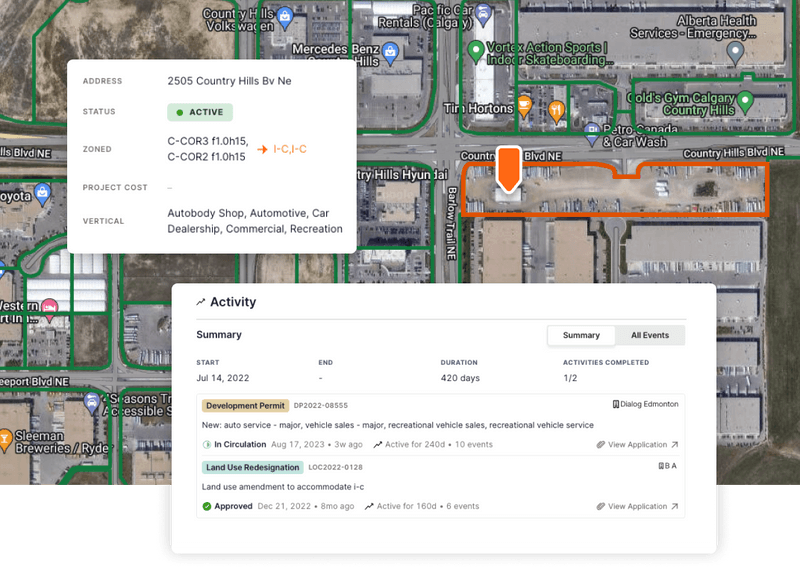
Our platform was purpose built to make it possible for anyone in the industry to discover, research, and action new projects efficiently without needing to rely on word of mouth.
Companies like Chandos Construction, Fillmore Construction, and CANA Construction shared how their teams are using Mercator and noted improvements across the board with efficiency, project discovery, market intelligence, and networking.
As we grow and innovate alongside our customers, our goal always remains the same – to support front of office teams with the external insights to make better decisions faster.
We’re looking for General Contractors, Product Manufacturers, and Construction Management companies ready to grow their businesses rapidly to join us as we continue to evolve Mercator.
Sound like you? Book a time to connect with our team and let’s build the future of market intelligence for construction together!


.png)