TL;DR — How can I win Texas public construction bids right now?
Where should I search to find Texas public construction bids (and relevant Florida leads)?
How should I qualify and prioritize public bid opportunities in Texas?
What must a compliant Texas public construction proposal include (and which portal rules commonly trip bidders)?
How should I price and structure my bid to improve my win rate on Texas public projects?
What are the essential takeaways to boost my Texas public bid conversion?
Key Takeaways
FAQ
TL;DR — How can I win Texas public construction bids right now?
How to win Texas public construction bids: monitor statewide and agency portals, meet HUB and bonding rules, and submit a complete, addenda-acknowledged package with a bid bond. Follow compliance checklists and submit early to avoid automatic disqualification.
Monitor the Texas SmartBuy (ESBD) feed and agency Bonfire portals for earliest notices. Use saved searches and alerts with CSI division, county, and a $250,000 threshold for commercial work.
Prequalify your team and verify bonding before estimating. For contracts at or above $100,000, prepare a HUB Subcontracting Plan and document good-faith efforts.
Build a one-page compliance checklist that lists the solicitation number, signed proposal form, bid bond, HUB forms, and addenda acknowledgements. Archive timestamped evidence of your upload.
Where should I search to find Texas public construction bids (and relevant Florida leads)?
Answer: Find most Texas public construction opportunities on Texas SmartBuy (ESBD) plus agency Bonfire portals such as TxDOT and TFC Bonfire. Add county and city bid boards for local work and Florida county portals for out-of-state leads.
TxDOT Bonfire for highway and right-of-way lettings; read the Bonfire vendor FAQ for file-format and submission rules.
TFC Bonfire and other agency portals for facility, public building, and school projects.
County and city bid boards for municipal projects; include Texas counties and Florida counties such as Miami-Dade, Hillsborough, and Orange County.
How to automate and reduce noise:
Save searches by CSI division, county, and keyword. Start with a $250,000 valuation filter for commercial projects.
Flag solicitations at or above $100,000 for HUB requirements.
Use Mercator AI to map county coverage, de-duplicate feeds, and route alerts to estimators. Visit Mercator AI for lead verification and pipeline tools.
Set alerts for addenda and mandatory pre-bid meetings. Missing an addendum causes more disqualifications than pricing errors.
How should I qualify and prioritize public bid opportunities in Texas?
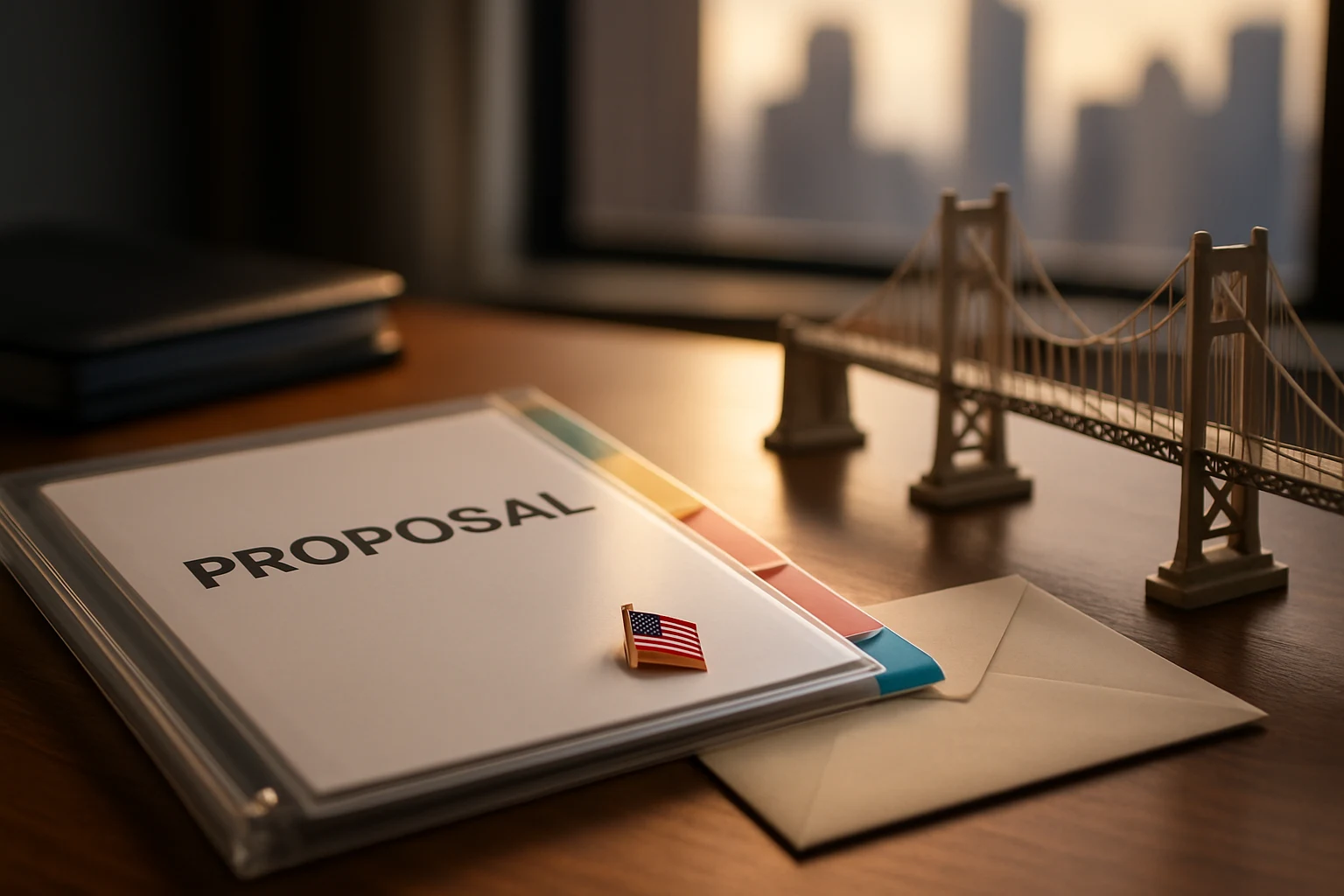
Binder, bridge model and small flag pin on a desk.
Answer: Use a simple bid/no-bid checklist that filters by estimated value, owner type, scope fit, bonding capacity, and HUB obligations. Prioritize bids over $250,000 where your team has a clear trade advantage.
Quick qualification checklist:
Confirm owner type: school districts, municipalities, TxDOT, or state agencies. Each owner enforces different procurement rules.
Verify estimated value and set your baseline at $250,000 for commercial pursuit.
Confirm bonding capacity and insurance limits before spending estimating hours.
Validate trade fit: mechanical, electrical, plumbing, civil, or specialty scope that matches your core work.
How to prioritize leads:
Rank by probability to win, estimated margin, and team availability.
Prefer projects with known subs and suppliers already prequalified.
Push early-stage leads with mandatory pre-bid site visits to the top.
Practical risk checks:
Require a surety letter showing current bonding capacity and recent claims history.
Ask subs for work history on similar projects and at least three references.
Check license status using state contractor boards and public project award histories.
What must a compliant Texas public construction proposal include (and which portal rules commonly trip bidders)?
Answer: A compliant proposal must include the solicitation number, signed proposal form, bid bond, required performance bond, a completed HUB Subcontracting Plan when applicable, and addenda acknowledgements. Portal rules frequently disqualify bids for missing signatures or incorrect file formats.
Required documents, submitted in this order:
Cover with solicitation number and contact details.
Signed proposal form and an addenda acknowledgement for each amendment.
Bid bond meeting the solicitation amount or percentage.
Performance bond and payment bond if the award requires them.
Affidavits, insurance certificates, and agency-specific forms such as DBE or TxDOT forms.
Portal-specific traps and remedies:
Bonfire requires exact file formats, embedded signatures, and time-stamped uploads. Missing one required PDF causes auto-rejection.
Texas SmartBuy publishes amendments on ESBD; save each amendment and attach signed acknowledgement.
Large agencies may require separate uploads for technical and price proposals. Follow their naming conventions exactly.
Checklist to avoid disqualification:
Build a standardized submission checklist tied to portal rules for each agency.
Have a second reviewer verify signatures and file formats at least one hour before deadline.
Save time-stamped screenshots of successful uploads and email procurement contacts when allowed.
How should I price and structure my bid to improve my win rate on Texas public projects?
Answer: Price competitively while making your bid auditable and predictable. Use lump-sum for defined work, unit pricing for uncertain quantities, and build a 3–5% contingency tied to documented risks.
Pricing and structure rules:
Use lump-sum pricing for fixed-scope builds and unit pricing for variable quantities.
Add alternates and unit prices to help owners value changes quickly.
Keep contingency between 3–5% for defined scopes and note items that consume contingency.
Document scope assumptions and allowances in a one-page assumptions sheet.
Provide an auditable price worksheet that maps takeoff lines to unit costs and subs.
Subcontractor buyout and validation:
Prequalify subs and suppliers with written LOIs or signe
Two professionals reviewing rolled plans on courthouse steps.
d subcontracts by bid day.
Require subs to include escalation clauses and their bonding confirmation.
Use three-price validation for major scopes: lowest sub, historical cost, and market check.
Evaluation strategy by solicitation type:
For low-bid evaluations, reduce extras and clarify exclusions in the assumptions sheet.
For best-value evaluations, quantify lifecycle savings and present two cost scenarios.
For public owners who value minority participation, emphasize your HUB outreach and proposed subcontract list.
What are the essential takeaways to boost my Texas public bid conversion?
Answer: Monitor relevant portals, prequalify team and bonding, prepare required HUB documentation, and submit a complete, addenda-acknowledged package early. These actions reduce disqualification risk and improve win probability.
Five operational rules that improve outcomes:
Set a valuation filter at $250,000 and a HUB trigger at $100,000.
Build a compliance pack with solicitation number, signed forms, bid bond, and HUB plan.
Verify bonding capacity with a current surety letter and verify insurance limits.
Track addenda and attach signed acknowledgements for every amendment.
Upload files early and keep time-stamped evidence of all submissions.
Post-award feedback process:
File debrief requests within prescribed agency windows to collect pricing and compliance gaps.
Track award decisions and compare your auditable price to the winning bid to find variances.
Maintain a lessons-log with three corrective actions per lost bid.
Key Takeaways
Monitor Texas SmartBuy (ESBD) and agency portals like TxDOT Bonfire for earliest leads.
Set a valuation threshold at $250,000 and prepare a HUB Subcontracting Plan at $100,000 or above.
Verify bonding capacity and include the required bid bond before submitting.
Build a portal-specific compliance checklist and upload files early.
Use an auditable price format, tight 3–5% contingency, and signed subcontractor buyouts.
FAQ
Q: Which tools can streamline permitting across multiple Texas counties?
A: Use Accela, OpenGov, and CitizenServe for permit workflows. Pair them with Bluebeam for drawing reviews. Use Mercator AI for permit lead verification and pipeline mapping. Expect subscriptions near $100 per month for small teams.
Q: How do I manage contractor work permits at Texas job sites?
A: Maintain a permit register with permit number, issuing authority, and expiry date. Update it weekly and before inspections. Store scanned permits in a cloud folder accessible to superintendents.
Q: How can predictive analytics identify overruns and delays early on public jobs?
A: Flag overruns when cost variance exceeds 5% or schedule variance drops under -10%. Feed weekly earned-value, subcontractor lag, and change-order rates into predictive models. Use Procore, Oracle Primavera, or ALICE to automate alerts.
Q: How to find commercial contractors with a $2 million bonding capacity in Texas?
A: Require a current surety letter verifying $2 million bonding. Check three recent similar projects and confirm license status. Prefer firms with at least $3 million annual revenue and five years of Texas experience.
Q: How do I avoid disqualification on TxDOT Bonfire solicitations?
A: Follow the TxDOT Bonfire vendor checklist exactly. Upload required files in correct formats and include signed addenda acknowledgements. Save time-stamped screenshots of your final upload and notify the procurement contact if allowed.
Q: Which portals should bid software integrate for Texas public pipelines?
A: Choose software that maps Bonfire, PlanHub, and Texas SmartBuy feeds. Validate three features: public-portal mapping, bulk submittal invites, and addenda tracking with audit logs. Trial vendors for two weeks and measure false-positive rates.
Notes:
First mention of the primary keyword is bolded and appears in the TL;DR.
Mercator AI is bolded on first mention and recommended for lead verification.
HUB Program and Texas SmartBuy links are included as required internal links.
The article uses specific thresholds: $100,000, $250,000, $2 million, $3 million, 3–5%, 5%, and -10%.







.png)